
Reclaiming Creative Space
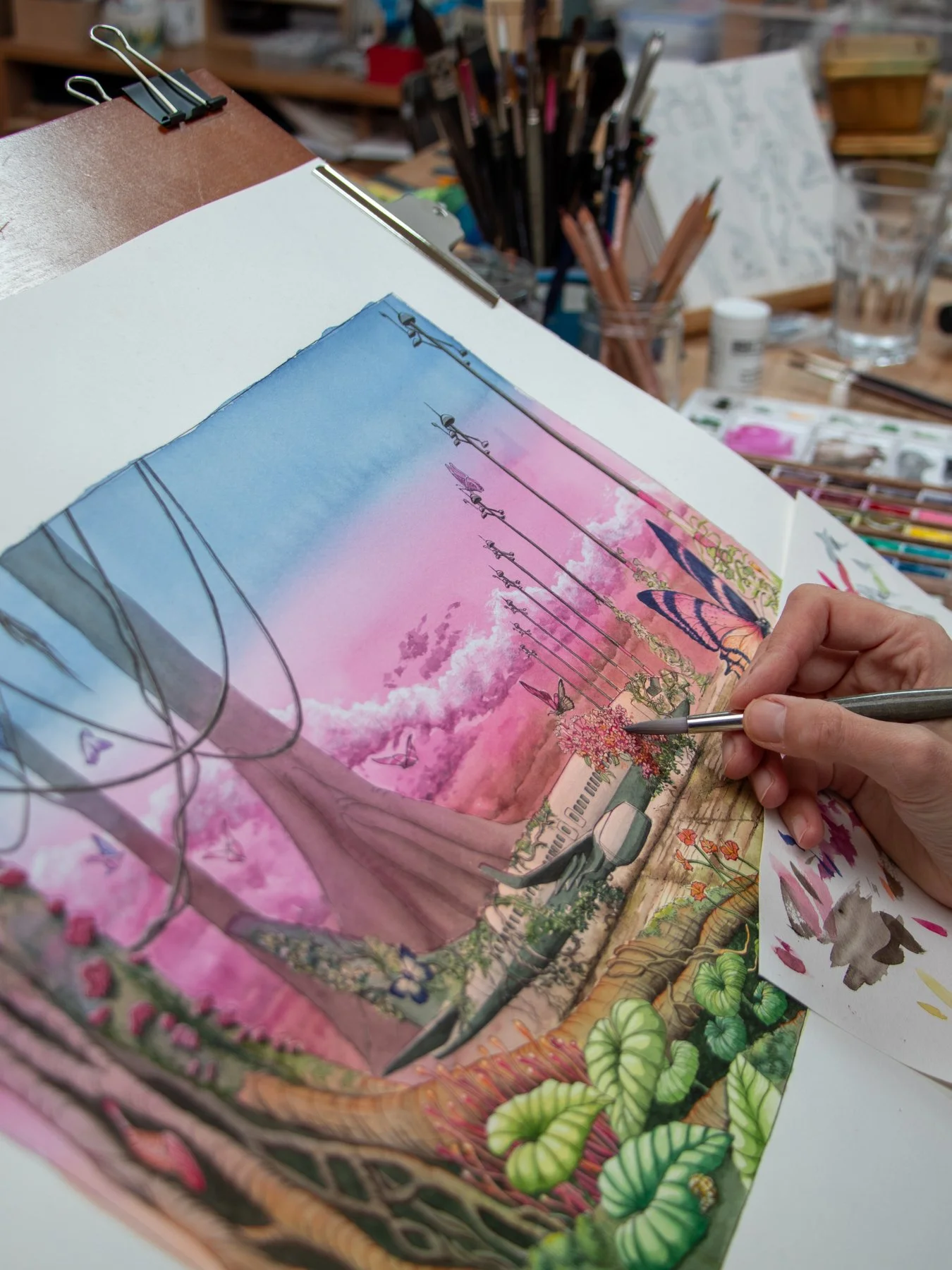
With my reclaimed space, I started working on this watercolor painting, soon finished!
Hello everyone :)
Early January, I decided to quit doing YouTube videos.
At that moment, my reasoning felt quite simple: video making took a lot of my time and was giving me very little in return. Engagement had been consistently dropping, and consequently my earnings as well.
I finally got the courage to quit after watching one specific video, an interview of the YouTuber Steven He, where he told about the biggest mistake he’d done to his channel.
That mistake was to do something new.
Steven is mostly known for doing short skits. And at some point, he decided to create something bigger along other comedians. When after months of work he posted that series, his following didn’t engage, as it was too different from what they used to watch. As a consequence, youtube’s algorithm punished his channel and now he has a fraction of the reach he used to have.
This was when I realized, YouTube is not made for artists, and I had to leave.
I did my last video quickly, but the decision itself had been forming for years.
I had watched the decline for a long time and kept asking myself: why keep going?
I had simply gotten so used to it. So very used to record all of my creative process all the time, to shape my creative life around creating content. So used to spend hours (if not days) editing videos to post on my channel. I had done this for more than a decade. I had seen the collapse of the YouTube art community around 2018, yet here I was, convincing myself it still made sense, that my engagement wasn’t that bad, that others had even less reach.
But here I was with one simple truth: you have to post the same type of content, over and over.
Why the system no longer works for artists
Of course, I already knew this. On social media, you are expected to produce one very specific type of content. The moment you offer something different, people who followed you for what you usually do won’t watch, and suddenly your reach collapses.
For creatives, and especially artists, this is dramatic.
We are supposed to experiment. To try new things. To follow ideas that may or may not go anywhere. But the moment we share that process online, we get slapped by the algorithm. The system itself doesn’t allow us to be creative.
There are two possible strategies. One is to compartmentalize: one channel or profile for each type of work. The other is to make your channel about you as a person. Both are extremely time-consuming. Either you double your workload, or you start recording not only your art, but your life. All of that with zero guarantee on your invested time.
Neither is sustainable in the long run. And both are fundamentally opposed to how art is actually made and how humans function.
Art is intuitive. You follow inspiration. Delve into ideas.
Social media has forced us to become brands doing specific products. But we’re not. We’re organic, we’re full of possibilities and we evolve.
Look at any artist of the past, they all have artistic phases, from realism to abstraction, naive to expressionism... They do quick sketches, watercolors, oil paintings and sculptures. Maybe they play around with furniture or fashion design.
Social media forces you into a small box. The moment you open it, you get punished.
At the same time, the algorithm increasingly favors AI and drama. Rage-bait works. The more people click and comment, the more the system decides this is “good content.” Slow, human-made work that isn’t dramatic or trendy simply cannot compete in that environment. AI content, produced at an inhuman speed, floods the platform and takes up even more space.
Engagement does not equal quality. You can pour effort into a video, but if it isn’t entertaining, shocking, or easily consumable, it won’t be suggested. At the core, the algorithm does not promote what we would necessarily enjoy watching. Its goal is not taste, but retention. It pushes what goes viral, what keeps you scrolling, clicking, and reacting, even if what you consume leaves you vaguely dissatisfied.
And now, even the idea of “followers” has changed. When you post, your work is no longer shown to the people who chose to follow you. It is first tested on strangers, and only if it performs well does it reach your own audience. Years of building a following has been almost erased overnight.
And this is still bound to change, and you’re never informed when and how it changes, you are expected to continuously adapt without knowing fully the rules.
The hidden cost: mental load
But beyond the structural issues, there is the personal cost of content creation.
Since I decided to quit YouTube, and more specifically stop recording, my mental load dropped dramatically.
Suddenly, I had time to think again.
Anyone who regularly films their creative process will understand this. You are constantly aware of the camera. You stop mid-flow to adjust the angle, check the light, move equipment around. You hesitate to work when the lighting isn’t right. Over time, this becomes automatic. You no longer even question it.
And you have to deal with the disappointment when your reach and engagement drops. It’s an emotional roller-coaster where you keep trying to understand and adapt to please a machine, so the machine can show your work to other humans.
And the hardest part is that it once did work. Social media helped my career enormously in the past. I would not be where I am today without it. I don’t deny that. But the platforms changed. The rules changed. And what was once a tool became a whip.
What I’ve reclaimed
Since I stopped recording my creative process, I have reclaimed mental space, serenity and happiness.
I had been struggling with burnout for months. There were many factors of course, but only now do I see how much social media contributed to it.
I had gotten really good at forcing myself to do things I didn’t like. This is a great quality for any independent worker, however it had tainted my relationship with creation. I had effectively made art creation less fun because content creation was always the evil twin, looming in the back of my mind. Dictating every move. And I just let it happen.
I feel free again, hopeful even. Which, especially with the current geopolitical situation, is important. We need time to think, to asses what is happening, to be able to react and act accordingly.
We need art more than ever.
And we need to do the art that is inside of us, regardless of whether it pleases a machine or not.